

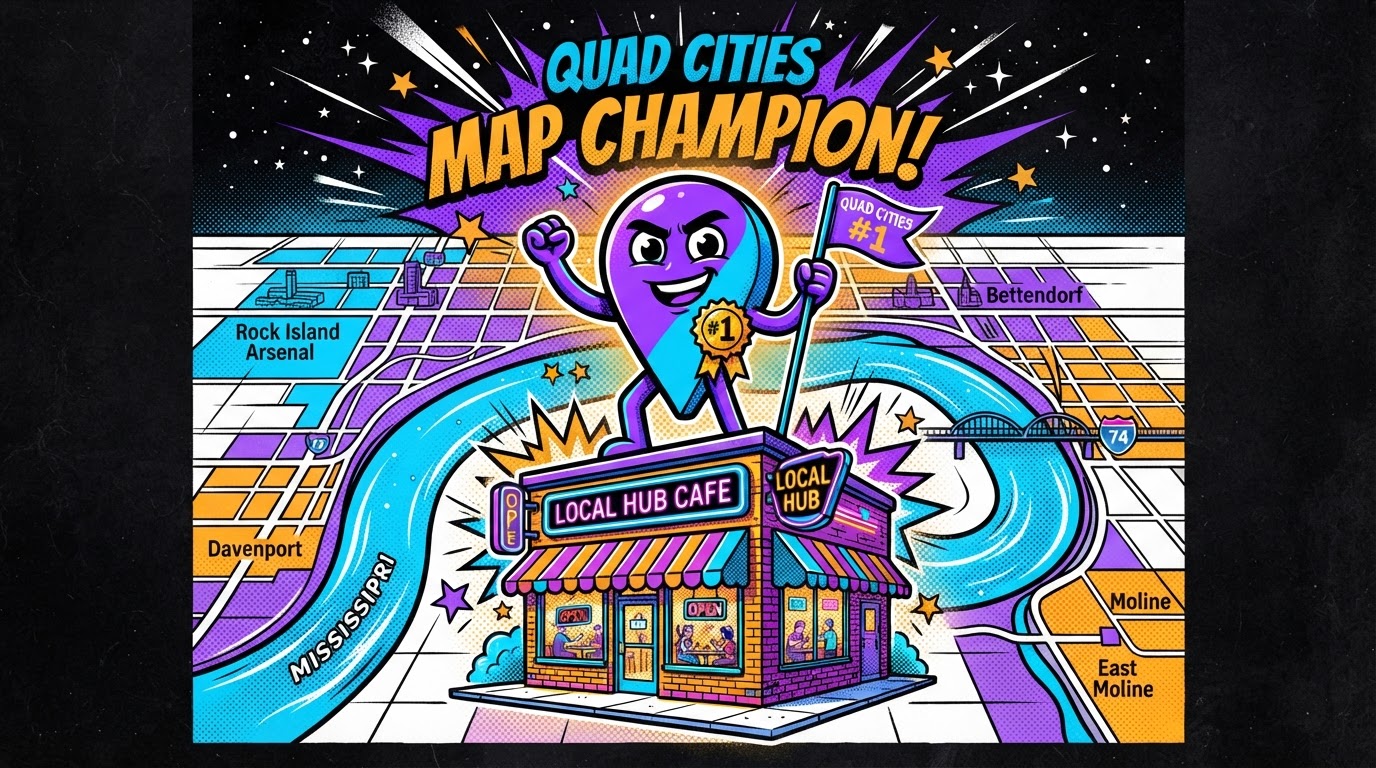
How to Rank in the Google Maps 3-Pack: The Quad Cities Playbook for 2026
A complete Google Business Profile setup is how to rank on Google Maps when you serve customers across the 563 and 309 area codes.
Disclosure: This article contains affiliate links. If you sign up through them, I may earn a commission at no extra cost to you. I only recommend tools I use and set up for real businesses.
Most Quad Cities business owners I meet are spending real money polishing a website almost nobody reads. They hire someone to rewrite the About page, chase backlinks, and tweak meta descriptions.
Meanwhile the Google Maps 3-Pack sits directly above that website in every local search, and it takes the clicks. When someone in Davenport searches "plumber near me," they do not scroll past the map. They call one of the three businesses pinned at the top.
This is not theory. I have set this up for real businesses on both sides of the river, from barbershops in Rock Island to med-spas in Moline. The playbook is the same everywhere, but the Quad Cities two-state dynamic adds a wrinkle most national guides miss.
1. Why the 3-Pack Is the Only Ranking That Matters Locally
The Google Maps 3-Pack is the box of three business listings at the top of a local search. It shows the name, rating, review count, address, and a button to call or get directions. It is the single most valuable piece of real estate in local search.
Here is the part that surprises owners. The 3-Pack does not link to your website first. It links to your Google Business Profile. A customer can call you, see your hours, read reviews, and book a job without ever touching your homepage. Your website matters, but it is the second click, not the first.
If you serve a local market, the 3-Pack is where the phone calls come from. Everything else is supporting cast.
2. The Three Signals Google Actually Ranks You On (Relevance, Distance, Prominence)
Relevance
Distance
Prominence
Google publishes the three signals it uses to rank local businesses: Relevance, Distance, and Prominence. Understanding how they actually work saves you from chasing the wrong tactics.
Relevance is how well your profile matches what the searcher typed. If someone searches "emergency roof repair Rock Island" and your profile lists you as a general contractor with no mention of emergency or roof work, you will not rank. Relevance is won in your categories, services list, and description.
Distance is how close you are to the searcher or the location they typed. This is the signal you cannot fully control. A Bettendorf plumber searched from Davenport loses to a Davenport plumber on distance alone. But distance is a tiebreaker, not a dictator. A better-optimized profile two miles away beats a bare profile next door.
Prominence is how well-known and trusted Google thinks you are. This is the signal you can move the most. It is driven by review volume, recency, velocity, profile completeness, and how active you are. The mistake I see most is obsessing over distance, which you cannot change, while ignoring prominence, which you can.
3. The Profile Audit: 9 Fields Most QC Businesses Get Wrong
Business name
Use your real legal name. Keyword stuffing triggers a penalty.
Primary category
Pick the most specific accurate category. "Plumber" beats "Contractor."
Secondary categories
Add every true relevant category. Never pad with services you do not offer.
Service area
List every city and zip you serve — both sides of the river, both states.
Services list
Add each service as its own item with a description and your keywords.
Description
Lead with what you do and who you serve, not your founding story.
Hours
Keep them accurate and update for every holiday. Wrong hours cost reviews.
Photos
Add real photos of work, team, and storefront. More photos, more calls.
Attributes
Fill every applicable one, from women-led to wheelchair accessible.
Before you post a single update, audit your profile. Most local businesses leave money on the table in these nine fields. The grid above is the exact checklist I run through on every new client in the QC.
The primary category is the single most important field for relevance. "Plumber" beats "Contractor." "Mexican restaurant" beats "Restaurant." Be precise, because Google matches the searcher's words to your category first.
The description gives you 750 characters. Use them. Lead with what you do and who you serve, not your founding story. Mention your service area by name so Google and the reader both know you cover both sides of the river.
4. The Weekly Routine That Compounds (Posts, Photos, Q&A, Reviews)
Complete Profile
Fill every field — categories, services, service area, hours, attributes. This makes you eligible to rank at all.
Weekly Signals
Post an update and add fresh photos every week. Google reads an active profile as a more prominent, trustworthy business.
Fresh Reviews
Ask every happy customer automatically. A steady stream of recent reviews is the heaviest prominence signal you control.
3-Pack Position
Eligibility plus activity plus prominence lands you in the top three — and the calls come in.
The profile audit gets you eligible. The weekly routine is what moves you up. Google treats an active profile as a more prominent one, so consistency beats perfection.
Post once a week. Google Business Profile posts expire after seven days. Treat it like a mini billboard: announce a seasonal special, a new service, or a local event you are sponsoring at the Freight House Farmers Market.
Add photos weekly. Upload a new photo of your work, your team, or your shop at least once a week. Google reads fresh photos as a signal that the business is active and real.
Ask for reviews consistently. Reviews are the heaviest prominence signal. You need volume, recency, and velocity, meaning a steady stream, not a burst once a year. The businesses that win the 3-Pack ask every happy customer. To understand the exact automation that asks for you, read how to get more Google reviews on autopilot — reviews feed the prominence signal more than any other tactic.
The loop is simple. A complete profile makes you eligible. Weekly signals tell Google you are active. Fresh reviews build prominence. Then the calls come in, and what you do after the call matters just as much — that is why I pair this with a missed-call text-back setup so no lead slips away.
5. Ranking Across the Iowa/Illinois Line: What Two-State Businesses Get Wrong
Home Services
Lead with emergency and 24/7 availability in your services list. Post before-and-after photos weekly.
Salon / Spa
Turn on the booking attribute and link your scheduler. Post seasonal offers and staff highlights.
Restaurant
Keep the menu updated and use the menu attribute. Post daily specials and event nights.
Clinic
Fill every attribute for insurance and accessibility. Post health tips and new services.
The Quad Cities is the only place in America where the Mississippi runs east to west. Your customers live in two states, pay two tax systems, and search from both sides of the river. Most two-state businesses get their local SEO wrong in two ways.
The first mistake is setting a single service area that covers only one state. If you are based in Bettendorf but serve Moline and Rock Island, your service area must list all of them. Google will not guess. If you do not tell it you serve the Illinois side, you will not rank for searches originating there.
The second mistake is creating fake listings for cities where you have no physical presence. Google suspends profiles for this, and recovering from a suspension is a nightmare. Use your real physical address for the listing tied to your location, and use your service area to communicate reach.
For home services especially, each missed call is worth roughly $1,200 in lost revenue. The 3-Pack is what generates those calls. If you are just starting out and want the full foundation, the Quad Cities online business guide walks through how to set up the entire operation from scratch.
Key Takeaways
- Claim and complete every field. A half-filled profile ranks like a closed business.
- Pick the most specific primary category. Precision beats breadth for relevance.
- Run the weekly routine. One post, a few photos, and consistent review requests compound over months.
- List your full two-state service area. Do not make Google guess which side of the river you serve.
- Treat prominence as the lever you control. Distance is fixed. Reviews and activity are not.
Ready to Launch Your QC Business?
Get direct help, local insights, and connect with other Quad Cities entrepreneurs.
Text DIGITAL to
563 396 9862
Standard msg & data rates may apply. We won't spam you.
About Lucas Dantas
Lucas Dantas is a Brazilian-born entrepreneur based in Bettendorf, Iowa, and the founder of Magnetic Funnels, an AI automation agency serving Quad Cities service businesses. A 2025 SaaSpreneur Gold winner, he has spent over a decade in CRM and marketing automation, setting up local SEO and lead systems for real businesses across Davenport, Bettendorf, Moline, and Rock Island. He writes Quad Cities Digital to give local founders the practical, no-hype playbook he wishes he had when he started.